
Choose your country / language
Global
Americas
-
 Argentina
-
 Brazil
-
 Canada
-
 Mexico
-
 USA
Europe
-
 Austria
-
 Belgium
-
 Czech Republic
-
 Finland
-
 France
-
 Germany
-
 Hungary
-
 Italy
-
 Luxembourg
-
 Netherlands
-
 Poland
-
 Portugal
-
 Romania
-
 Slovakia
-
 Sweden
-
 Turkey
-
 United Kingdom
Asia
-
 China
-
 India
-
 Indonesia
-
 Japan
-
 Korea
-
 Malaysia
-
 Philippines
-
 Singapore
-
 Vietnam

Since August 12, 2026: PFAS-free plastics production for food packaging – is it possible?
High-performance PVD coatings help manufacturers move toward more sustainable plastics production for food packaging.
Additives such as PFAS improve melt flow, stabilize plastics processing and help ensure consistent product quality. Due to environmental and health concerns, however, manufacturers increasingly need to modify their formulations. PFAS-free PVD coatings from Oerlikon Balzers support the efficient processing of modified formulations and comply with the new EU requirements.
PFAS (per- and polyfluoroalkyl substances) are highly stable fluorinated chemicals used as processing aids in plastic melts or as release agents. They reduce friction between the polymer melt and metal surfaces and help prevent processing defects such as melt fracture, sharkskin effects, nozzle build-up and drooling. In addition, they reduce adhesion and improve the surface quality of the final product.
Their high stability, however, is also what makes PFAS problematic. They persist in the environment, contaminate soil and water, and accumulate in the human body. PFAS-containing additives are particularly critical in food-contact applications because they may migrate into packaged food. Since August 12, 2026, specific PFAS limits under the EU Packaging and Packaging Waste Regulation (PPWR, Regulation (EU) 2025/40) apply to food-contact packaging.
Modified formulations can create processing challenges
To comply with these requirements, plastics manufacturers need to modify their formulations using alternative or additional processing aids to maintain flow behavior and release properties. However, these alternatives do not always deliver the same performance as PFAS. As a result, the interaction between polymer formulation, process conditions and tool surface becomes increasingly important.
Michael Bilo, Key Account Manager Plastics at Oerlikon Balzers, describes the challenge: “We have customers producing multi-layer PE/HDPE barrier films for food packaging. Each layer measures only a few micrometers (µm). Without PFAS, these materials can no longer be processed as reliably at such low thicknesses. Film stability decreases, tears occur more frequently, and nozzle build-up as well as drooling occur significantly more often.”
Such issues are not limited to PFAS replacement. New additives, bio-based polymers and recycled materials can create similar challenges.
“Customers often come to us when a new formulation causes processing problems. We analyze tool geometry, substrate material, surface condition and the specific defect pattern within the context of the production process and the polymer being used,” says Michael Bilo.

High-performance, PFAS-free PVD coatings from Oerlikon Balzers support stable production and high packaging film quality. Photo: iStock
PVD coatings: Less adhesion, less wear
PVD coatings for melt-contact surfaces support the process where PFAS-containing additives previously provided important processing properties. They improve sliding and flow behavior, reduce adhesion and deposit formation, and protect against corrosion.
With BALINIT® CROMA PLUS and BALINIT MOLDENA, Oerlikon Balzers offers PFAS-free, REACH-compliant solutions for extrusion, injection molding and die casting that support compliance with the requirements of the EU Packaging and Packaging Waste Regulation.
Both coatings are exceptionally hard and highly resistant to wear, corrosion and oxidation. They reduce adhesion and deposit formation on tool surfaces, extending the service life of screws, barrels, dies, nozzles and mold inserts. BALINIT MOLDENA is particularly suitable for abrasive materials such as glass-fiber-reinforced plastics, plastics with high flame-retardant content and recycled materials.
Spiral distributor coated with BALINIT CROMA PLUS: PFAS-free surface technology for improved material flow and extended maintenance intervals. Photo: Oerlikon Balzers
Longer tool life, lower production costs
Coated tools achieve longer service life, reduce maintenance and tooling costs, and minimize unplanned downtime. In tests with BALINIT MOLDENA, 200,000 injection cycles and more were achieved while maintaining consistent part quality, compared with approximately 40,000 cycles using a standard coating. More stable processes, reduced adhesion and improved surface quality simultaneously increase production efficiency and lower part costs.
Wear-reducing PVD coatings that minimize adhesion on tool surfaces help mitigate the effects of modified formulations. They stabilize material flow, extend cleaning intervals and reduce downtime. At the same time, these coatings contribute to sustainability by extending tool life and supporting the reliable processing of new and recycled plastics.
This enables the plastics industry to maintain efficient production and consistent quality while meeting regulatory requirements as well as the expectations of customers and consumers.
-
pdf ()
Technical article: PFAS-free plastics production for food packaging – is it possible?
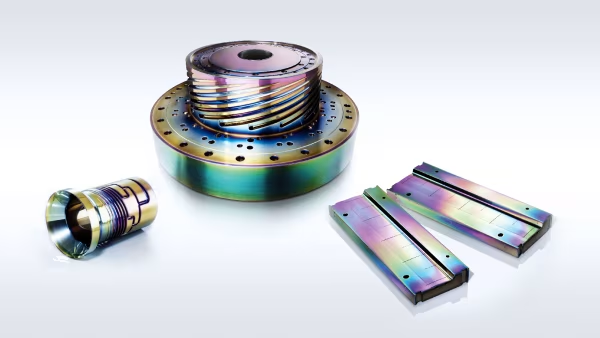
BALINIT CROMA / CROMA PLUS
With BALINIT CROMA, your plastics processing will be in top form even for large components.
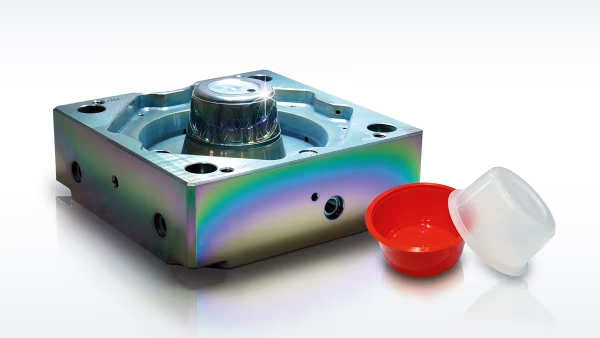
BALINIT MOLDENA
The new coating for injection moulding & extrusion of filled polymers

Sustainable coating solutions: The future of surface technology
Compelling reasons to switch from hard chrome to PVD
Contact