


Aluminum is key to the sustainable automobile. Beijing Benz Automotive relies on the technologies of Oerlikon Balzers when punching and casting the metal.

Choose your country / language
 Argentina
 Brazil
 Canada
 Mexico
 USA
USA
 Austria
 Belgium
 Czech Republic
 Finland
 France
 Germany
 Hungary
 Italy
Italy
 Luxembourg
 Netherlands
 Poland
 Portugal
 Romania
 Slovakia
 Sweden
 Turkey
 United Kingdom
 China
China
 India
India
 Indonesia
 Japan
Japan
 Korea
Korea
 Malaysia
 Philippines
 Singapore
 Vietnam

The reinvention of metal stamping at Beijing Benz Automotive
Aluminum is key to the sustainable automobile. Beijing Benz Automotive relies on the technologies of Oerlikon Balzers when punching and casting the metal.
You might not think that automotive origins would be uncovered in archaeological sites whose artifacts date to the 5th century BC. After all, this is the century when Pheidippides ran 42 kilometers from Marathon to Athens – a distance he could have covered much faster if he’d had access to a rental car. But in that same era, the ancient Chinese had already processed iron, and they went on to invent the method for making steel. We couldn’t get behind the wheel or onto the highway today without the work of those pioneering ironworkers.
And speaking of pioneers: You also might think of cars as an early 20th century invention. But in fact, the first motorized (“horseless”) carriage appeared in 1886 – the work of two German gentlemen named Karl Benz and Gottlieb Daimler.
Given those twin histories of innovation, it’s no surprise that automotive R&D thrives at Beijing Benz Automotive Co., Ltd., a Mercedes-Benz subsidiary. Today, the company’s priorities include initiatives that promote environmental protection. Major OEMs have issued requirements for vehicle weight reduction as a means of increasing fuel efficiency and reducing emissions. To comply with those demands, the company must reduce the weight of sheet metal parts as much as possible without compromising rigidity and strength.
The obvious material to achieve these goals is aluminum, but the company faces many challenges in developing this solution. “These changes will place high requirements on molding, such as the molding of aluminum alloy,” says Li Shanshan, Stamping Senior Manager, Manufacturing Engineering. “The relevant parameters may not simply be copied from the existing parameters for steel molding. We need to start all over again.”

The Pulsed-Plasma Diffusion treatment process reduces scratches and wear between sheet and die during production which leads to less workload of our offline die maintenance.
Li Shanshan, Beijing Benz Automotive Co., Ltd.
The team relies on Oerlikon Balzers as a partner in this reinvention of automotive metal forming and design. Surface technologies such as Pulsed-Plasma Diffusion (PPD) are proving to be game-changers in improving both the stamping process and the durability and maintenance requirements of parts. Beijing Benz Automotive has applied the PPD treatment process to the molding of some key components, such as the side and fender, of the best-selling C-Class automobiles on the market.
“It is actually able to improve the wear resistance of our dies, and hence reduce scratches and wear between the sheet and die in the production process,” Li Shanshan says. “This can indirectly extend the service life of the die and therefore reduce the workload of our offline die maintenance, especially in terms of die care.”
The carbonbased BALINIT TRITON STAR coating technology delivers an additional competitive advantage in aluminum sheet stamping by “ reducing the adverse effect of aluminum scraps on our product quality,” which “is very helpful in ensuring normal production,” says Zhang Dongwei, Stamping Process Supervisor, Manufacturing Engineering. “We used this coating technology on two aluminum parts for our E-Class model to solve the aluminum scraps issue that is prone to occur during production. In Europe, the application of this technology is likely standard use. In China, however, we may have been the first OEM to have used this technology.”
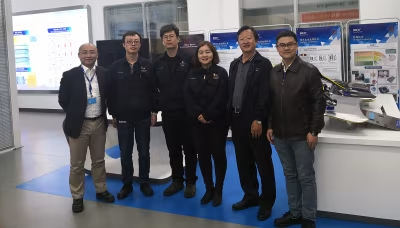
There are more firsts ahead, in China and throughout the world. The automotive industry is pursuing strategies for making environmental protection as much a part of its identity as individual mobility and distinctive style already are.
Demand for vehicles is accelerating in emerging markets. The United Nations projects that the planet’s population (currently 7.6 billion) will reach 8.6 billion by 2030, 9.8 billion by 2050, and stand at 11.2 billion in 2100, meaning that billions more consumers are on the way. And as the urbanization trend packs more and more people and vehicles into metropolitan areas, air pollution has created an urban health crisis.
For Beijing Benz Automotive, these trends signify a need to lead the industry not just in automotive innovation, but also in environmental responsibility and stewardship. The company therefore is committed to employing technologies that redefine best practices in metal stamping, forming, and surface treatment – practices whose end benefits support the automotive industry’s contributions to the beginning of a cleaner, healthier, and more sustainable world. Its partnership with Oerlikon Balzers creates the opportunity to develop OEM solutions that can take current advances even farther.
“This approach to collaboration is a hallmark of our team’s approach to R&D,” says Henry Guo, Head of Tools at Oerlikon Balzers China. “The more the engineers understand the challenges their customers face and the standard
s the industry is establishing, the better equipped they will be to introduce innovations that deliver enhanced production, improved fuel efficiency, and meaningful gains in the reduction of carbon emissions.”
By working together, the two companies are already realizing the potential that surface treatment technology has to achieve these results. As they continue to define industry challenges and pursue more advanced solutions, they are well positioned for a productive ongoing relationship.
© Copyright 2026 OC Oerlikon Management AG
Back to top keyboard_arrow_up